Top 10 Temu scams and how to avoid getting tricked online


Low prices and a vast selection of products attract millions of users to Temu. Alongside legitimate vendors, scammers can also operate on the platform. Elsewhere, cybercriminals may impersonate Temu sellers and staff to run scams.
Knowing how to identify the telltale signs of a Temu scam can help you stay safe while shopping. This guide explains everything you need to know about the most common scams on Temu, how to avoid them, and what to do if you fall victim to one.
What are Temu scams?
Temu scams are online scams that specifically target Temu users. They range from counterfeit goods sold on the platform to scammers that masquerade as Temu itself. While virtually all scammers are ultimately out to make money, some do this by acquiring personal information and account access credentials rather than soliciting direct payments.
Why is Temu targeted by scammers?
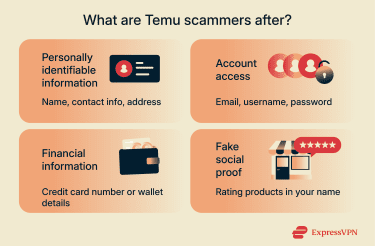 These factors combine to make Temu an attractive target for scammers:
- A vast user base from all over the world means there are many potential victims to target.
- With new users joining regularly, there are always inexperienced users who don’t know how the site works and what to avoid.
- Cybercrime, particularly when it crosses borders and the sums of money are relatively small, is hard to prosecute.
- The aggressive pricing strategies sellers use on the site make it harder to differentiate between great deals and offers that are too good to be true.
- A long logistics chain (Temu, sellers, shipping, buyers, etc.) provides ample entry points for scammers.
- Seller verification relies on documentation provided by sellers, and scammers may attempt to misuse or misrepresent information to open new seller accounts.
How Temu scams typically work
In most cases, Temu scammers are after either direct payments or valuable information. They tend to make false claims that payments are owed or use other means to trick victims into providing login or payment details.
Broadly speaking, Temu scams fall into these categories:
- Social engineering: This refers to manipulation tactics that aim to trick targets into freely giving up information or taking specific actions. It usually involves scammers communicating with victims over email or by phone and pretending to be Temu or a legitimate seller.
- Spoofing and phishing: This is the act of getting potential victims to open emails or web pages designed to look like they are affiliated with Temu. They may use almost identical designs, URLs, or email addresses to convince victims to give up passwords or credit card details.
- Unauthorized account use: Threat actors actively impersonate Temu users, either by breaking into accounts or creating new ones.
- Seller misrepresentation: There are some sellers on Temu that deliberately misrepresent their products, generate fake reviews, or act dishonestly in other ways. They rely on real users to unknowingly boost their profiles.
Top 10 Temu scams to watch out for
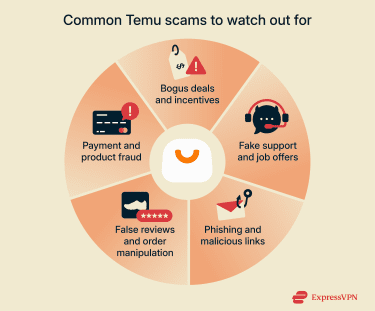 Scammers are constantly refining their techniques and finding new ways to trick victims. Many Temu scams don’t fit neatly into a single category, as they use a combination of strategies. That said, shoppers looking to stay safe ought to familiarize themselves with common scam formats.
Fake promo codes
These scams usually tempt Temu users to hand over personal data in exchange for discount codes. Often, tricksters spread these alleged coupons through online ads or social media sites.
The victim is usually asked to provide their name, email address, or mailing address to get the deal. Once they do, they either won’t get a promo code at all, or they’’ll receive one that doesn’t work. If the scammer succeeds in getting personal information, it may spread more widely, increasing the victim’s overall digital footprint.
Other scammers may give away promo codes seemingly without asking for anything in return. However, instead of giving any discounts, the code may simply give referral benefits or rewards to the person sharing it. While not particularly harmful, this is still deceitful and can be frustrating.
Be suspicious of any promotions that offer unusually high discounts, especially if they claim to apply site-wide or come with no conditions attached, like a maximum total value.
Gift card scams
In addition to promo codes, scammers are also known to offer fake Temu gift cards, including in regions where Temu does not officially issue gift cards. Since gift cards typically have a higher value and appear more reliable than coupons, scammers often have an easier time convincing victims to complete additional tasks in order to "earn" the benefit.
For example, the victim may be asked to make a small purchase in order to earn a card with a much higher value. Alternatively, the scammer may request that the victim downloads an app or completes a long and detailed survey as a first step. These chores are actually just opportunities to gather personal information or spread malware.
Any promise of a free gift card is likely a scam. Even if you’re asked for basic details like your address, be cautious with such offers.
Customer service impersonation
If scammers get hold of the victim’s contact information, they may contact them pretending to be a Temu representative. Usually, scammers claim that the victim’s account has an issue, such as a problem with a recent payment or allegation that they’re implicated in fraud.
By making the victim worried and confused, scammers hope to prevent them from thinking clearly. If the victim responds, the scammer typically asks for more information, like credit card numbers or login credentials. Alternatively, the cybercriminals may demand the target pay a fee to clear up a non-existent issue.
Be aware that Temu will never ask you for sensitive information over email or text message. If anyone claims there’s an issue with your account, log in through the website in a separate tab and look for an alert.
Fake Temu websites
Scammers also operate spoofed versions of the Temu site. If the victim doesn’t realize that it’s a fake right away, they may enter login credentials, payment information, or physical address, effectively handing sensitive information over to scammers.
Always check your browser’s address bar to make sure you’re on Temu’s actual site. Make sure the page has an HTTPS certificate, that is, check whether it starts with “https://” and look for a warning from your browser. Note that HTTPS alone is not proof that a website is legitimate. Other red flags include generic e-commerce terms as part of the domain, like “outlet,” “store,” “deals,” etc.
Affiliate or ad links sometimes take you to a Temu page with a very long URL. The difference between this and a fake URL is that the domain (www.temu.com) remains unchanged.
Aside from the URL, look for small inconsistencies in the website’s design, spelling or grammar errors, excessive popups or ads, and unrealistic deals.
Affiliate link traps
An affiliate link is a unique URL that sites share with partners. When someone uses the link to visit Temu and makes a purchase, the affiliate that shared it gets a reward. Affiliate links often provide some benefit to the buyer as well, like a special reward or discount.
There are many real Temu affiliates that help users save money. However, there are also plenty of fakes. At best, these misleading affiliate links only benefit the affiliate who shared them, not the actual buyer. At worst, they may be part of a phishing scheme.
As always, be wary of offers that are too good to be true. Similarly, don’t trust any link that takes you to a login page if you normally don’t need to provide a password before accessing Temu.
Brushing and order tracking scams
Temu scams don’t only come from outside scammers; some sellers on the platform may also use underhanded techniques to dupe unsuspecting buyers.
One of the most common underhanded tactics is called brushing. This is when sellers send unsolicited packages to Temu users to artificially inflate their profile standing by showing they have made more sales. They often pair these shipments with fake reviews to boost ratings.
Receiving unexpected (and free) orders may seem harmless, but it may indicate that your name and address have been leaked. In some cases, items sent may even be unsafe, mislabeled, or not compliant with local regulations.
Importantly, brushing has a negative impact on the whole platform, giving bad sellers undue attention.
Phishing via email and SMS
It’s common for scammers to reach out to users via email or SMS claiming to be Temu. This can be a first step toward many of the scams on this list. Users on the site often receive messages from Temu; scammers exploit this expectation to get their foot in the door.
On Temu, phishing attempts often come in the form of fake order tracking links. Once clicked, the buyer is redirected to a page claiming that their identity must be verified. In reality, it’s just another front to steal information.
Temu uses a number of domains when emailing users, which makes scammers harder to identify. The domains may vary across countries, but legitimate messages generally come from temu.com, temuemail.com, temumail.com, temuofficial.com, or temufavor.com, though domains can vary by region and may change over time..
That said, domains can be faked, so look for grammatical mistakes, unrealistic claims, and urgent calls to action. It’s wise to familiarize yourself with other strategies that you can use to prevent phishing attacks.
In general, when a text or email gives you a reason to visit Temu, it might be a good idea to access the site through your bookmarks or by entering the address into a new tab. If you think you’ve entered details on a phishing page, change your password immediately.
Fake job offers
Scammers may pose as employers or hiring agents with attractive offers to work at Temu or make easy money as a seller. They often claim to have found the victim’s information through LinkedIn, an agency, or job sites like Indeed. Victims are lured in with promises of highly paid remote work.
Job scams can work in a number of ways. Some may only harvest personal information, but others go further, asking “new hires” to download malware, pay for training materials, or take care of upfront fees before their compensation can be transferred.
In addition to appearing unexpectedly in your inbox, you might encounter these scams on legitimate work platforms like Fiverr or Upwork.
Counterfeit goods
There have been reports from some users about counterfeit, misrepresented, or very poor-quality products sold on Temu. The platform is large and the process of registering as a seller is fairly easy, so there isn’t much stopping scammers. Some take advantage of this by selling cheap products that they present as high-end items.
Any product from a luxury brand that is suspiciously cheap is likely a knock-off. Similarly, many users have complained about sellers using AI-generated imagery to misrepresent their goods.
Credit card fraud
A common goal of Temu scammers is to trick victims into handing over their payment details. Many of the scams mentioned above see scammers asking for such information. If you provide it, it’s possible they’ll go on to make purchases without your knowledge.
How to shop safely on Temu
For the most part, you should follow the same best shopping practices you would on other online marketplaces. Broadly, this means researching what you buy, having realistic expectations, and familiarizing yourself with common scams.
Use secure payment methods only
Temu is compliant with industry-standard payment security practices, like Payment Card Industry Data Security Standard (PCI DSS). It supports various broadly trusted payment options, like Visa, MasterCard, Apple Pay, Google Pay, and many country-specific processors. Nevertheless, there are still measures you should take to stay safe.
First off, follow Temu’s advice: only pay vendors through the platform. If a seller recommends using a third-party service, they might be a scammer. Any requests made after a purchase to provide additional payment for shipping are also likely to be part of a scam.
It’s also generally a good idea to pay with a credit card or other method that supports chargebacks. Temu does offer refunds, but it’s reassuring to have extra protection just in case.
Always verify seller profiles
Before you buy, scan the seller's profile and product pages for any red flags. A good first step is to look for a purple Star seller badge next to their name. This badge provides details about quantifiable factors that make the seller stand out. Temu also shows how long most vendors have been active on the platform. The longer a storefront has been open, the more likely it is to be reputable.
Buyers should also check reviews and ratings. A large number of reviews and high average rating are positive signs, but be suspicious if you see an unrealistic count in a short time period. Further, read a few reviews and try to determine whether they’re genuine or appear to be written by bots.
Many Temu sellers are also active elsewhere. Look for any links to other websites and check these out. If you don’t find anything suspicious, that’s a good sign that the vendor is reliable.
Look for red flags before buying
Before buying, examine each product page thoroughly. Even if a particular seller appears trustworthy, there could be other signs that a specific product might fail to meet your expectations:
- Misleading pictures: Some sellers use stock images or photos of other products. Look for signs that images are generated by AI and check buyer reviews to see if anyone has provided their own pictures.
- Abnormally high or low prices: A product may be much cheaper than similar items because it’s poorly made. On the other hand, a higher price may be nothing more than price gouging.
- Vague or contradictory descriptions: The text description should match what you see in the product photos and name. Look closely for contradictions in the description.
- Suspicious reviews: Too many reviews with fake-looking usernames, short descriptions, and contradictory positive feedback are all suspect. Also look for reviews that seem to describe entirely unrelated products.
- Unclear technical specs or certification: Products like clothes, electronics, and cosmetics should come with precise details about things like size, ingredients, and technical specifications. Products should also carry the relevant certification or safety ratings in your country.
- Delivery times: Double-check the delivery times, as overly long delays may indicate dropshipping or a fake listing. Legitimate products may still take more than a week if they’re sent from overseas, but in most circumstances, anything more than a month is generally suspicious.
Enable two-factor authentication
Temu allows you to turn on two-factor authentication (2FA) for your account. In addition to creating a strong password, link your account to your phone number or an authenticator app. Once set up, you’ll need to enter a one-time password (OTP) each time you log in.
This makes it harder for someone else to access your account to write fake reviews or purchase items without your authorization, even if your password gets compromised.
What to do if you’ve been scammed on Temu
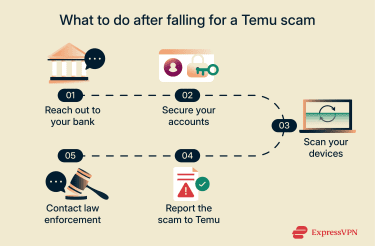 If you think you’ve fallen for a Temu scam, stay calm. Depending on what happened, you may not need to follow all of these damage-control steps, but it’s a good idea to know what your options are.
Contact your bank or credit card provider
If you suspect that a scammer has your payment details, contact your bank or credit card company and request that they cancel any compromised cards. You can usually do this via the bank’s website, mobile portal, or by calling the fraud hotline.
Depending on the nature of the scam, your bank may reimburse you. If you received a counterfeit or otherwise unsatisfactory product, it’s best to request a refund through Temu before reaching out to your bank.
For other scams, whether you’ll get a refund largely depends on whether you authorized the payment or not. If a scammer convinces you to pay for an extra service, you’re unlikely to get your money back. But it’s generally worth reaching out, so be prepared to provide them with the details of the scam.
Create new passwords for compromised accounts
If you believe you’ve fallen for a phishing attempt or similar scam, change your password for the relevant account immediately. Log into the site in a fresh tab and navigate to the account settings page. Be sure to use a password that you don’t use on any other site. If you’re fast enough, you may be able to prevent any damage.
Priority should be given to your email account and those that provide access to a number of other services (like your Apple, Google, or Facebook accounts). If a scammer can get into your email inbox, they can likely seize control of other accounts that aren’t protected with 2FA.
Scan your device for malware and use a VPN
Some Temu-related scams can lead to malware infection if a victim installs malicious software provided by scammers. Whether through a drive-by download, a fake app related to a job scam, a malicious email attachment, or a bogus Temu app, malware could end up on your device.
If you downloaded or installed anything in the course of the scam, you should immediately run a scan to check for malware. An antivirus running in the background may detect and block virus downloads before they complete, so it’s best to keep yours on at all times.
You may also want to consider taking extra steps while shopping online, like using a virtual private network (VPN). In addition to encrypting your connection, some VPNs come with extras like ad and tracker blockers. Some, like ExpressVPN’s Threat Manager, block domains known to be malicious, potentially preventing you from visiting a dangerous site.
All that said, while antiviruses and VPNs can help in a few concrete ways, no software can make you immune to job scams or prevent you from purchasing counterfeit items. Use the security tools available, but common sense and caution are the best defense.
Report the scam to Temu
Depending on how the scam happened, Temu might be able to take some immediate action to recover your funds and act against the scammer. Any transaction details that you can provide (transaction IDs, timestamps, etc.) may be helpful in opening an investigation.
You can also report sellers through a button on the relevant product page or through the website.
File a complaint with authorities
After taking care of immediate concerns like securing your accounts and finances, you may want to report scammers to law enforcement. In the U.S., the Federal Trade Commission (FTC) handles reports from consumers.
Though you’re unlikely to get any assistance with recovering your funds, the authorities do take actions based on reports, so you may help prevent others from being scammed in the long run.
FAQ: Common questions about safety on Temu
Is Temu a trustworthy platform?
Temu itself is a reputable company, but the site is open to pretty much anyone, and scammers are active on the platform. Given that it has millions of users, there are lots of potential targets. In addition to vendors selling fake goods, scammers also impersonate Temu outside the platform.
How can I avoid Temu scams?
You can avoid Temu scams by using secure payment options, reviewing sellers and products, and practicing good account security. Always make sure that you only interact with emails, texts, and links that come from actual Temu representatives. Don’t make payments outside of the platform and be wary of any deal that sounds too good to be true.
What are the red flags to look for on Temu?
Unusual pricing, suspicious user reviews, and inconsistent product descriptions are all signs of a scam. Be especially careful of supposed affiliates or influencers trying to entice you with time-sensitive offers. Furthermore, real Temu customer support will never ask for sensitive information over email or SMS.
Can I get my money back if scammed?
Temu or your credit card company may be able to reimburse you, but this isn’t always the case. If you receive a fake product, Temu will usually provide a refund. If you fall for another scam, whether your bank will pay you back or not depends on the circumstances, bank policies, and applicable laws. Report the incident and be prepared to provide details.
Are all Temu sellers verified?
Sellers need to provide some documentation to register on Temu, but this isn’t much of a barrier to professional scammers and counterfeiters. Before making a purchase, buyers should look for red flags to determine their trustworthiness.
Take the first step to protect yourself online. Try ExpressVPN risk-free.
Get ExpressVPN