How to create a family privacy policy for sharenting and online life



New YouGov research shows privacy matters to parents and children. Here’s how families can agree on shared rules for posts, apps, messages, location sharing and growing independence.
Families have rules for almost everything. Children learn when they can have their first phone, which apps they’re allowed to download and how late they can stay online. Parents set limits around spending, screen time, gaming and social media. Schools send home policies covering devices, photographs and acceptable online behaviour.
Privacy is often handled less clearly. Children hear familiar warnings about strangers, passwords and personal information, while adults make hundreds of smaller decisions of their own. They post family photographs, share news in group chats, use location-tracking tools and give apps access to contacts, cameras and photo libraries. Those decisions belong to the same conversation, yet many families have never agreed on the rules.
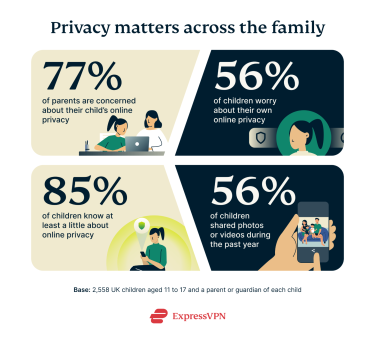
New YouGov research for the VPN Trust Initiative surveyed 2,558 UK children aged 11 to 17, alongside a parent or guardian of each child. It found that 77% of parents were concerned about their child’s online privacy. Children cared about it too, with 56% saying they worried about their own privacy and almost 85% saying they knew at least a little about the subject.
More than half of the children surveyed had shared photographs or videos during the previous year. Parents also share photographs, stories and updates about their children, a practice commonly known as sharenting. Privacy decisions are being made throughout the household, sometimes by several people at once.
A family privacy policy gives those decisions a common foundation. It can cover what parents post, what children share, who can contact them, when locations are visible, and how responsibility changes as children grow.
“Families already have plenty of rules around technology, but they often sit on the child’s side of the relationship,” says Pete Membrey, Chief Research Officer at ExpressVPN. “As a dad, I think the most useful privacy rules are the ones children can see the adults around them following too. That gives everyone a shared standard rather than another list of warnings.”
Sharenting is where children first see the rules in action
Sharenting covers a wide range of behaviour. It might be a public social post, a private photo album, a school update sent to relatives or a video shared in a family WhatsApp group. Most parents share because they’re proud, want to record an important moment or hope to include people who live far away.
The deeper privacy question concerns how the decision is made. A parent may tell a child to ask before posting a photograph of a friend, then upload a photograph of that child without mentioning it to them. They may warn against revealing locations while sharing a school, sports club or regular family routine in their own posts.
Children notice how those rules work in practice. Sharenting can therefore become one of the earliest ways parents demonstrate consent, audience choice and restraint.
UNICEF’s guidance on sharenting recommends involving children in decisions about what gets shared as they become old enough to express a view. The discussion itself can help children understand consent and encourage them to respect other people’s privacy when they begin posting independently.
A young child can’t assess the reach of a public post, so the parent still needs to make the decision. That doesn’t prevent adults from talking through it. A parent might explain that a photograph is being sent to grandparents but won’t be placed on a public account, or that a school logo has been left out because the family keeps location details private.
As children grow older, they can take a larger role. They might approve the photograph but ask for a different caption, agree to family sharing while declining a public post, or decide that an achievement belongs online while a difficult personal moment doesn’t.
“Children learn privacy through the choices they see us make,” explains Membrey. “When a parent asks before sharing, explains who will see something and accepts a child’s answer, that’s a real lesson in consent. It’s much more memorable than simply telling them to be careful online.”
A family privacy policy has to reach beyond the family feed
Sharenting is a useful starting point because it makes the issue easy to see. The same principles apply to many other parts of family life online.
A policy should cover photographs and stories, along with messages, profiles, app permissions, location sharing and new privacy tools. It should also explain what a child can expect from their parents when something goes wrong.
That final point matters. Parents’ leading concern in the survey was inappropriate contact from strangers, selected by 65%. Misinformation, screen time and cyberbullying also ranked highly. A family can reduce some exposure through settings, although children still need a clear route back to an adult when a message, request or interaction becomes uncomfortable.
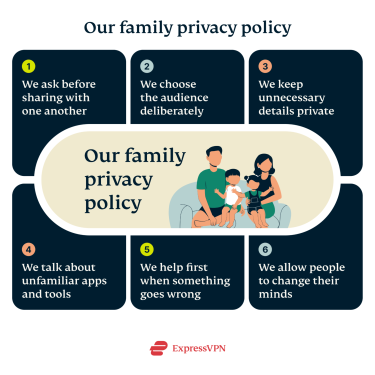
The policy doesn’t need to resemble a contract. A handful of shared commitments can establish how the household approaches privacy.
The policy should change as children grow
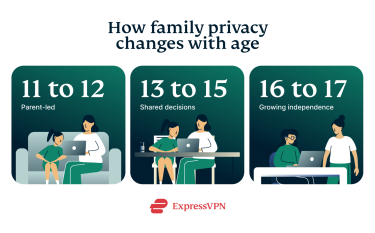
The research shows how rapidly the balance between oversight and independence changes during the teenage years.
Content filters were used on the devices of around 60% of children aged 11 to 12. That dropped to 40% among 13- to 15-year-olds and 20% among 16- to 17-year-olds. At the same time, the proportion with no parental controls rose from 9% among 11- to 12-year-olds to 52% among 16- to 17-year-olds.
The fall in controls makes sense as children gain experience and independence. A teenager approaching adulthood will manage more of their relationships, accounts, spending and travel without a parent making each decision.
Families still need to decide how that responsibility is handed over. Removing a control doesn’t automatically give a child the judgement to recognise manipulation, assess an unfamiliar app or know when a request for personal information has crossed a line.
Around ages 11 to 12
Parents are likely to lead most decisions and use more technical controls. They can begin showing children how those decisions are made by explaining app permissions, audience settings and why certain family information stays private.
Sharenting decisions still sit mainly with the adult, although children can be asked how they feel about photographs and stories. Listening at this age helps establish that their view matters before social pressure becomes more intense.
Around ages 13 to 15
Decisions become more shared as social lives move into group chats, gaming communities and private accounts. Children can take greater responsibility for their settings while parents remain involved in new apps, purchases and unfamiliar contacts.
Parents can also review their own sharenting habits with the child. This is often the age when an old photograph that once seemed sweet begins to feel embarrassing, especially when classmates can search for it.
Around ages 16 to 17
The teenager should lead most everyday privacy decisions, with the parent available as a source of help and perspective. The family can agree on the smaller number of situations that still need a check-in, such as unusual app permissions, payments, threats or requests for intimate images.
Adults should also recognise the teenager’s growing ownership of their public identity. A proud family update may still matter to the parent, but the young person should have a meaningful say in how their image, results, relationships and experiences are shared.
“Parental controls can be useful, especially when children are younger, but settings can’t make every judgement for them,” says Membrey. “The long-term goal is to hand over responsibility gradually. Parents stay available, while the child gets more practice making privacy decisions before they have to manage everything alone.”
Privacy tools can start a useful conversation
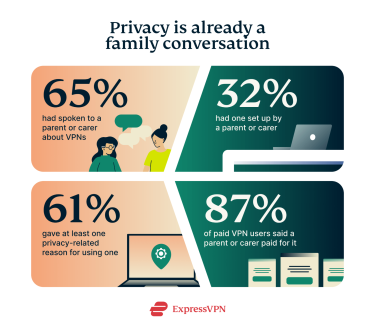
The survey also suggests that children’s privacy choices aren’t always hidden from their families. Among children who had used a VPN, 65% had spoken to a parent or carer about it. Almost a third had one set up by a parent, while parents paid in the vast majority of cases where a child used a subscription service.
These conversations give parents an opportunity to understand the need behind the tool. A young person may be concerned about location tracking, personal information, public Wi-Fi or what an app can see. Among young VPN users, 61% gave at least one privacy-related reason for using one.
The same approach can apply whenever a child asks for a new app, a private social account or a location-sharing service. Parents can ask what the child wants it to do, who operates it, which information it requests, and whether the settings match the reason for using it.
A family policy can set different expectations by age. A younger child may need approval before installing anything. An older teenager may manage ordinary downloads independently while agreeing to ask for help when an app requests extensive access, handles payments or makes claims that are difficult to verify.
“Curiosity gets parents much further than assuming a privacy tool signals bad behaviour. Ask what problem the child wants to solve and what they think the app protects. You’ll learn more from that conversation than you will from the icon on their phone.”
Rules only work when children can admit something went wrong
A family privacy policy needs to account for mistakes. Children and adults will sometimes post too much, trust the wrong account, click a convincing link or give an app permissions they later regret.
The response matters because a child who expects an immediate punishment may try to conceal the problem. They need to know they can report an unwanted message, scam, embarrassing post or request for an image while there’s still time for an adult to help.
Parents can agree to deal with the immediate issue first. That may involve blocking an account, saving evidence, changing a password, reporting content or checking what information has been shared. Consequences and wider lessons can follow after the child is safe and the situation is contained.
The same standard applies to adults. When a child asks for a post to be removed, the conversation should focus on their privacy rather than whether the parent considers the content embarrassing. Respecting the request shows that the family policy has real meaning.
“A policy nobody feels safe admitting they’ve broken won’t protect anyone,” warns Membrey. “Children need to know that asking for help comes before the lecture. That keeps the conversation open when the stakes are higher than a normal disagreement about screen time.”
Start the new school year with six questions
A family doesn’t need to solve every privacy issue in one sitting. The beginning of the school year offers a natural point to review what has changed and which decisions a child is ready to take on.
The conversation can begin with six questions:
- What are we each comfortable sharing about one another?
- Which family details should stay out of public posts?
- Who can currently see our profiles and locations?
- Which new apps, accounts or online groups have appeared this year?
- What will happen when someone receives unwanted contact or shares something they regret?
- Which privacy decisions is the child ready to manage independently now?
The answers will look different in every household. They may also change during the year as a child gets a new phone, starts travelling alone, joins a social platform or asks for greater control over how the family posts about them.
Privacy is something families practise together
Sharenting gave us a word for the record parents create about their children online. It also raises a broader question about the privacy standards children see at home.
Parents are concerned about their children’s privacy, and children are developing concerns and habits of their own. A family privacy policy brings those perspectives together across social posts, messages, locations, apps and the gradual move towards independence.
No household will follow every rule perfectly. A shared policy still gives children a model they can recognize and gives parents a clearer way to hand over responsibility without withdrawing support. The best back-to-school privacy rules are the ones every member of the family can see themselves following.
All survey figures, unless otherwise stated, are from YouGov Plc. The total sample consisted of 2,558 UK children aged 11 to 17 and a parent or guardian of each child. Fieldwork was conducted online between 5 and 22 June 2026. The figures were weighted and are representative of UK children aged 11 to 17 by age, gender, region, Index of Multiple Deprivation and ethnicity.