 Celebrate with up to 80% off
What is internet governance? A clear guide to the rules shaping the internet


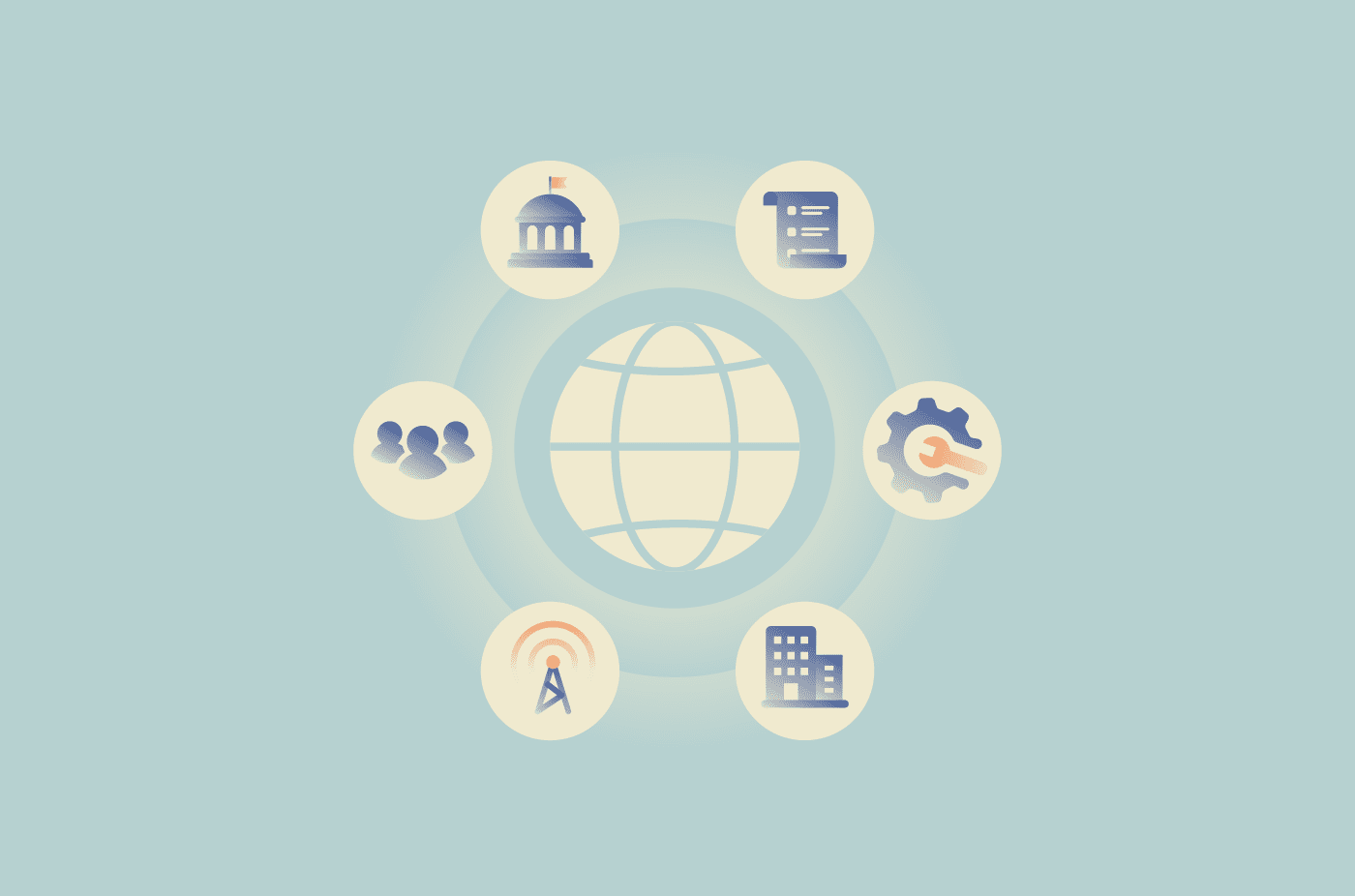
Internet governance is the set of rules, standards, organizations, and systems that shape how the internet works. It covers everything from how websites get their names and how data moves between countries to how online safety and privacy are handled.
For everyday users, internet governance can influence things like what you can access online, how personal information is handled, and the security and reliability of digital services. For businesses and governments, it affects things like how digital services are built, regulated, and shared across borders.
Internet governance in history
The internet started in the late 1960s as a research project called ARPANET, funded by the U.S. government and developed by academics and engineers. Its primary purpose was to support communication and resource sharing between connected research computers.
Because of this, early coordination was mostly technical rather than policy-driven. In other words, engineers agreed on shared technical standards to make sure different systems could work together. There was less need for formal global governance structures or regulatory frameworks.
In the 1980s and 1990s, ARPANET expanded and connected with other early research and academic networks. The internet stopped being a small experimental system and became a global network used by governments, businesses, and the public.
This shift meant that informal coordination among engineers was no longer sufficient, and new institutions and processes emerged that shared the responsibility for managing the rapidly expanding global network.
What areas does internet governance cover?
Internet governance spans several key areas, each addressing a different aspect of how the internet operates, from its technical foundations to who can access and participate in it.
Internet infrastructure
Internet governance influences how the basic infrastructure of the internet is organized and maintained. This includes overseeing the Domain Name System (DNS) and the allocation of public IP addresses. It also covers technical standards and protocols like Transmission Control Protocol (TCP) / Internet Protocol (IP), which defines how data is moved over the internet.
Data privacy and user rights
Data privacy addresses issues like what information websites and companies can collect, use, store, or share. Specific rules vary by region, as different regions have different approaches to regulating personal data. For example, the European Union has a framework called the General Data Protection Regulation (GDPR), while California has the California Consumer Privacy Act (CCPA).
Cybersecurity and online safety
Cybersecurity frameworks, standards, and legal requirements help guide how organizations secure their systems. They also cover how companies should respond when security incidents occur, including breach reporting requirements.
Digital access
This area of internet governance is concerned with who can access the internet and how evenly that access is distributed. It looks at barriers such as cost, infrastructure availability, geographic location, and digital skills.
Why internet governance matters
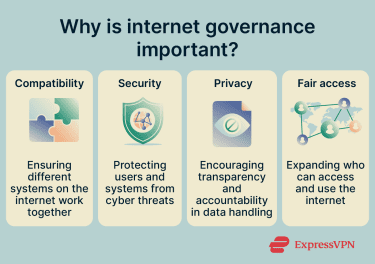 Internet governance has wide-ranging benefits for both businesses and individuals, including:
- Maintaining compatibility: Without agreed-upon standards and protocols, different systems might not work properly together. For example, without standards, two computers from different manufacturers might not be able to exchange data.
- Enhancing security: Standards, best practices, and regulatory frameworks can help organizations improve cybersecurity and reduce risks from threats such as hacking, data breaches, identity theft, phishing scams, malware, and internet fraud.
- Protecting user privacy: Regulation helps balance the needs of digital services with the protection of user privacy. Privacy laws and governance frameworks can influence how organizations collect, store, and share personal information online.
- Ensuring access: Expanding internet access is another area associated with internet governance. This can include efforts related to infrastructure availability, affordability, and digital literacy.
How internet governance is structured
Internet governance is commonly described as using a multi-stakeholder approach. In other words, it involves the participation of several different groups rather than being controlled by a single authority.
This structure reflects the fact that the internet affects a wide range of people and systems across different countries. Decisions made in one part of the internet often have consequences that extend beyond a single jurisdiction or organization.
The internet is also an immensely complex system, requiring input from different areas of expertise such as engineering, law, policy, and consumer protection. No single group has all the knowledge or authority needed to address every aspect of how it functions or is governed. For example, a government may pass a law on online data use, but it still depends on private companies to implement it through the systems they operate.
The multi-stakeholder approach is intended to help address these challenges by allowing different perspectives and areas of expertise to contribute to how the internet is coordinated and maintained.
Major stakeholders in internet governance
Below are the main actors involved in governing the internet and what their typical responsibilities are.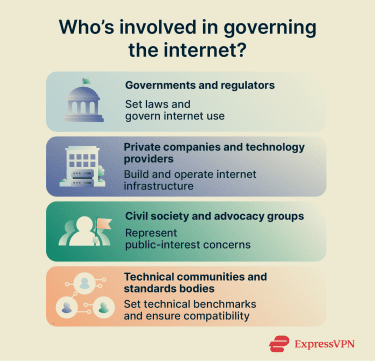
Governments and regulators
Governments and regulators play a central role in internet governance by creating and enforcing the legal frameworks that shape how the internet is used within their jurisdictions. This includes laws and policies related to privacy, cybersecurity, online content, competition, and digital rights.
They’re also responsible for representing national interests in international internet policy discussions and agreements. In these settings, issues such as cross-border data flows, standards, and digital trade are negotiated. This often involves engagement with global forums like the Internet Governance Forum (IGF) and institutions such as the International Telecommunication Union (ITU) when coordination beyond national borders is required.
Private companies and technology providers
Private companies and technology providers build and operate much of the infrastructure that keeps the internet running. This includes:
- Internet service providers (ISPs).
- Domain name registries and registrars.
- Root server operators (organizations that maintain core parts of the DNS).
- Cloud providers.
- Online platforms and digital service providers that provide access to content and services (e.g., search engines, social media platforms, app stores).
Civil society and advocacy groups
Civil society organizations, consumer groups, and academic institutions contribute perspectives related to privacy, internet access, consumer protection, and the social impact of internet policy and technical decisions.
Examples of these groups include:
- Digital rights organizations (e.g., Electronic Frontier Foundation).
- Consumer protection organizations.
- Community networks that promote local access and connectivity.
- Academic and research institutions studying internet policy and governance.
Technical communities and standards bodies
Technical communities and standards bodies define global standards and practices that keep the internet interoperable and reliable. For example, the Internet Engineering Task Force (IETF) develops voluntary technical standards that allow different systems and networks to work together. Another important organization is the Internet Corporation for Assigned Names and Numbers (ICANN), which helps coordinate key internet resources like domain names and IP addresses.
Current issues and trends in internet governance
Internet governance continues to change as new technologies emerge and as governments, companies, and other actors respond to new challenges. The topics below highlight some of the main issues and developments shaping how the internet is governed today.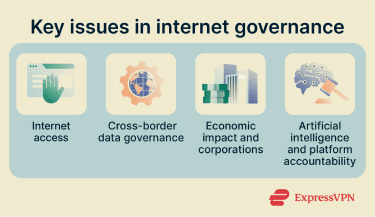
How access and content are governed across borders
Governments may restrict access to websites or block services within their jurisdictions. Online platforms also influence what users see through content moderation policies under their terms of service. This may include restricting access to certain websites, removing content, blocking online services, or requiring platforms to follow local laws and platform governance requirements.
Different countries and organizations take different approaches to these issues based on their legal, regulatory, and policy priorities. However, because the internet operates across borders, these differences can create challenges for global platforms and services that must comply with multiple legal and regulatory frameworks at the same time.
Cross-border data governance
Regulating the internet can be difficult because it operates across national borders, while laws and enforcement mechanisms are typically designed at the national or regional level. This makes it challenging to apply rules consistently across different jurisdictions. It’s an issue that’s become more visible in recent years as the internet has grown increasingly central.
An example of this is how data protection rules can differ significantly between countries. For a global service, this can create complex situations where data must be handled differently depending on a user’s location.
Economic impact
A small number of large digital platforms play a major role in global online markets. This has raised concerns about market concentration and the level of influence they have over access to digital services and infrastructure.
In response, governments and regulators around the world have introduced rules aimed at addressing issues such as market concentration and competitive practices. An example of this is the EU’s Digital Markets Act.
At the same time, there’s an ongoing debate about how regulation affects innovation and economic growth in the digital sector. While some argue that stricter rules are necessary to ensure fair competition, others raise concerns that overly strict regulation could slow development or increase compliance costs.
Artificial intelligence and platform accountability
AI use has expanded rapidly in recent years, and it's now central to how many online platforms operate. It's used for everything from ranking to moderating content. Many platforms also offer AI chatbots or assistants.
A key concern is that AI systems are often opaque, meaning it can be difficult to understand how or why they produce specific outputs. This can make it harder to identify issues in a system and therefore to challenge them. For example, it may be difficult to determine why an automated system flagged, ranked, or removed certain content.
The opacity has also created issues related to accountability. It’s difficult to assign responsibility for problematic outputs when the cause cannot be traced. This can leave users with limited avenues for recourse.
These debates have intensified as AI adoption has accelerated and legal and regulatory frameworks continue to evolve.
FAQ
Who sets the rules for the internet?
How is internet governance different from internet regulation?
What role does ICANN play in internet governance?
How do countries cooperate on internet governance?
How does internet governance affect everyday users?
How can businesses prepare for changing internet rules?