Expressvpn Glossary
Fixed wireless access (FWA)
What is fixed wireless access?
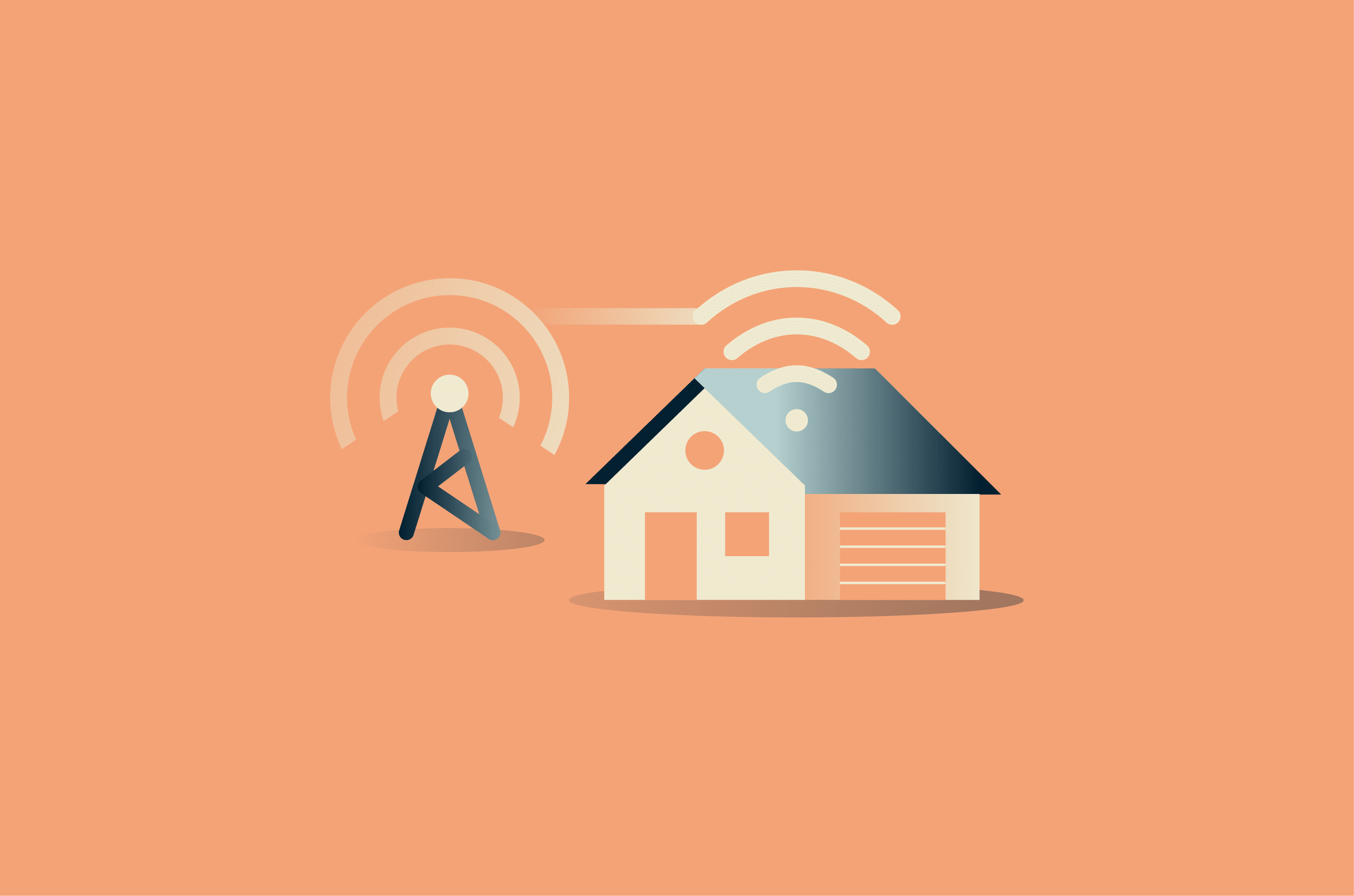
Fixed wireless access (FWA) is broadband internet delivered through radio signals instead of physical cables. A receiver installed at the customer's location connects to a nearby base station, creating a wireless link for internet access.
How does fixed wireless access work?
FWA works by creating a wireless connection between the customer’s location and an internet service provider (ISP) network.
The provider operates nearby base stations or cellular towers that are already connected to its core systems through high-capacity connections such as fiber or microwave links. These towers then broadcast internet signals via radio waves.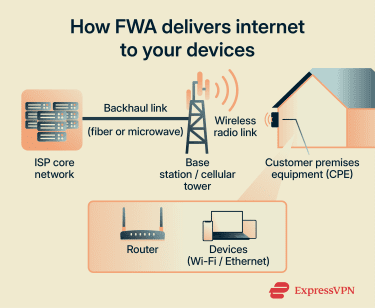 At the customer’s site, a device known as customer premises equipment (CPE) receives the signal from the tower and passes the connection to a router inside the building. The router distributes the connection to devices using Wi-Fi or Ethernet.
Internet traffic travels wirelessly between the CPE and the tower, then moves through the provider’s network to reach the wider internet.
Where is fixed wireless access used?
FWA is most often used in places where running new cables isn’t practical or cost-effective. This includes homes outside dense urban areas or small offices that need internet service without waiting for new fiber or cable lines to be installed.
It’s also used in situations where the receiving location may change or only needs connectivity for a limited time, such as construction sites or temporary workspaces. FWA networks can also be set up during disaster recovery or emergencies.
Some organizations use FWA as a backup connection so they can stay online if their primary wired service goes down.
Types of fixed wireless access
- Long Term Evolution (LTE)-based services: 4G LTE technology broadcasts a signal between an ISP’s radio tower and the customer’s receiver.
- 5G fixed wireless: 5G delivers higher potential speeds and lower latency than 4G. It operates on either sub-6GHz or millimeter-wave (mmWave) bands. Sub-6GHz provides better coverage but slower speeds, while mmWave provides fast speeds but only over short, line-of-sight ranges.
- Licensed spectrum: Signals travel over frequencies exclusively reserved by the provider, reducing interference and boosting speeds.
- Unlicensed band: Signals travel over free public or open frequencies. Often cheaper but can be unreliable due to interference.
- Indoor CPE: Receiver sits inside near a window when signal strength is sufficient.
- Outdoor antenna: Equipment mounts externally to improve signal quality when coverage is weaker or the tower is farther away.
- Point-to-multipoint (P2MP): Base sends signal to multiple customer locations.
- Point-to-point (P2P): Base sends signal to one customer location for dedicated and more reliable connections.
What affects fixed wireless access performance?
- Signal strength and obstructions: Stable speeds require a clear path between the equipment and the base station. Distance, terrain, trees, and buildings weaken the signal and reduce consistency.
- Network load: If capacity is shared among users on the same base station, speeds can drop during peak hours.
- Frequency tradeoffs: Signals that cover wider areas penetrate obstacles better but offer slower speeds. Signals that deliver faster speeds don't travel as far.
- Weather: Severe weather can occasionally affect signal quality, though it's usually a minor factor compared to distance and obstacles.
Benefits of fixed wireless access
- Improved coverage for underserved areas: Broadband can be provided to regions that were previously relying on legacy lines like copper telephone wires.
- Quick deployment with minimal on-site disruption: Links can be installed without trenching, and indoor CPE avoids running cables through walls.
- Scalable infrastructure with lower costs: New towers and cellular upgrades can extend the network without the expense of laying more physical lines.
- Increased competition for ISPs: FWA offers an alternative for customers, which can improve prices and services in the area.
- Portable CPE: CPE can be moved within the base station’s range for temporary or changing sites.
Limitations, security, and privacy considerations
The majority of FWA ISPs encrypt traffic between the CPE and the provider’s network using cellular protocols. However, unlicensed bands or legacy FWA networks might use unencrypted transmissions. This puts those connections at risk of interception or spoofing (when rogue devices or fake base stations insert themselves into the network).
Privacy with FWA works the same way as with other ISP-provided internet services. All traffic passes through the provider’s infrastructure before reaching its destination, and providers may log or manage traffic based on their policies and local regulations.
Many FWA providers also use carrier-grade Network Address Translation (NAT), which means multiple customers share the same public IP address. This can prevent inbound connections and cause issues with hosting servers, certain online games, or remote access setups.
Further reading
- Types of internet connections
- How to get internet in rural areas
- How much internet speed do I need?