

What is an AI search engine? How AI search works and why it matters



Most people are already familiar with traditional search engines: you type in a query and get a list of links to explore. AI search builds on this by emphasizing the meaning, context, and intent behind a query. Instead of only returning links, AI search engines generate direct answers, summarize information, and help refine queries in a more conversational way.
This changes how people find and interact with information. Rather than clicking through multiple pages, users can get a clearer overview upfront and explore follow-up questions more naturally.
This guide explains what AI search is, how it works, why it matters, and how to choose the right tool.
What is an AI search engine?
An AI search engine is a tool that combines search or information retrieval with AI models. It may search the open web, a private database, uploaded documents, or another source base, then use AI to summarize, explain, or organize the results.
In practice, an AI search engine isn’t always a separate app from an AI chatbot. The same tool can often be used in different ways. For example, ChatGPT may function like a chatbot when you ask it to draft an email or brainstorm ideas but like an AI search engine when you use ChatGPT Search to look up current information with links to web sources. Similarly, Gemini and Microsoft Copilot can work as conversational assistants, but they can also search the web or draw on search results.
Other tools are more search-first: Perplexity describes itself as an AI-powered answer engine, while Google’s AI Overviews and Bing Generative Search add AI-generated summaries or richer AI responses to traditional search results.
Compared to traditional search, AI search can:
- Generate direct answers in natural language.
- Summarize information from multiple sources.
- Respond to follow-up questions in a conversational way.
How AI search differs from traditional search
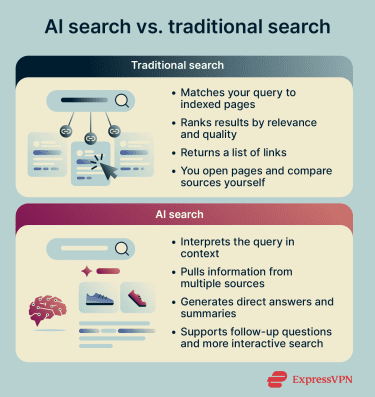
Traditional search engines like Google or Bing primarily use web crawlers to index pages across the internet. When you enter a query, they:
- Match it against indexed content using keywords and semantic signals.
- Rank pages based on relevance, quality, and other factors.
- Return a list of links for you to explore.
AI search builds on this foundation but handles results differently. Instead of only pointing you to relevant pages, AI search systems:
- Synthesize information from multiple sources.
- Generate direct answers rather than listing links.
- Highlight key points so full pages aren’t always needed.
- Support follow-up questions, making the process more interactive.
Why AI search is becoming more important
AI-driven search is becoming more important because it reduces the effort needed to find and understand information. Traditional search engines are still effective, but they often require opening several sources, comparing details, and combining them into a complete answer. This is especially true for more complex, specific, or multi-part questions.
AI search tools focus on handling more of that process by combining information from multiple sources, generating summaries or direct explanations, and allowing you to refine your query through follow-up questions in the same interaction.
AI capabilities are increasingly being added to existing search engines. Google and Bing now include AI-generated responses alongside standard results, meaning this approach is becoming part of how search works rather than a separate category.
As a result, adoption of AI tools is growing. More people are using AI to ask questions, compare options, and get quick explanations. In late 2025, S&P Global reported that 46% of the 2,500 U.S. internet adults they surveyed had used at least one generative AI tool. Similarly, Microsoft reported that roughly 1 in 6 people worldwide had used generative AI tools by the second half of 2025.
How AI search engines work
AI search engines combine traditional search technology with AI systems, including neural networks, that help interpret and organize information.
Neural networks are a type of AI model inspired by the human brain. They process information through layers of interconnected nodes, allowing the system to recognize patterns and relationships between words and context. This helps AI search provide results that are more relevant, accurate, and readable.
However, at a basic level, AI search engines still search through large collections of webpages, documents, or other digital content.
From query to results: How AI processes a search
When someone enters a search, the system first breaks the query into smaller parts to understand what’s being asked. This includes identifying key terms, the main topic, and whether the query is looking for a definition, explanation, comparison, or recommendation.
AI search engines then use natural language processing (NLP) models to interpret language in context rather than as isolated keywords.
They also rely on transformer-based neural networks, such as Generative Pretrained Transformers (GPT) and Bidirectional Encoder Representations from Transformers (BERT). These models capture relationships between words in a sentence, helping interpret meaning and intent more accurately.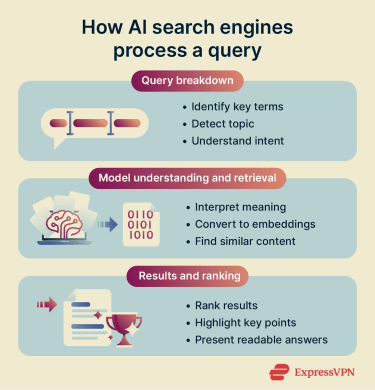
To compare meaning at scale, the system converts both the query and content into vector embeddings. These are numerical representations of language that capture semantic meaning, allowing similar ideas to be grouped closer together.
These embeddings can then be compared using similarity search techniques, often based on approximate nearest neighbor (ANN) methods. This helps identify content that is conceptually similar to a query, even if it doesn’t use the same wording.
Many systems also use an approach called retrieval-augmented generation (RAG). This combines traditional search retrieval with AI generation. The system retrieves relevant information from sources, then uses an AI model to summarize and present it as a more direct response.
Key features of AI search engines
AI search engines include features that shape how results are presented and explored. The sections below highlight the most common ones and what they do in practice.
Semantic and context-aware search
Semantic search engines focus on meaning rather than exact wording. In simple terms, it understands what a search is about, even if the phrasing is unusual or incomplete.
For example, someone might ask, “What movie has a twist where the hero turns out to be the villain?” A traditional search engine would typically match parts of that query to indexed pages, often returning results that don’t fully align with the description.
AI search systems, by contrast, are better suited to interpret the full intent of a conversational query like this and narrow down a more specific answer.
Context-aware search adds another layer by looking at how words relate to each other. This matters because the same word can mean very different things depending on the rest of the sentence. For example, the word “jaguar” could refer to an animal, a car brand, or a sports team, depending on whether the query is about wildlife, vehicles, or sports.
Together, these capabilities help AI search engines interpret questions in a way that feels more natural and less dependent on perfect wording.
Conversational search experiences
One of the biggest changes in AI search is that it often feels more like a conversation than a traditional search. Instead of typing short fragments, people can ask complete questions in a more natural way. This makes AI search feel less rigid, since queries don’t need to be reduced to keywords or structured like commands to be understood.
In many cases, AI search engines are also designed to support follow-up questions. For example, a user might start with “best headphones,” then refine the search by asking for noise-cancelling options, a specific price range, or preferences like over-ear versus in-ear. Each follow-up builds on the previous response, allowing the system to adjust its answer without starting from scratch.
This back-and-forth interaction makes search feel closer to a dialogue than a single query and result. It’s especially useful for broad, layered, or exploratory topics where the user is still defining what they need.
AI-generated summaries and direct answers
Many AI search engines can present information in a more digestible format by creating summaries or short direct answers based on what they find.
Unlike traditional search engines, which may generate a one-off summary like a featured snippet or AI overview for each individual query, AI search tools maintain context across a conversation. This allows them to refine or adjust answers based on follow-up questions, rather than treating each search as a completely separate request.
As a result, users can move through a topic more naturally. They can start with a broad question and gradually narrow in on more specific details without needing to restart the search process each time.
Personalization and relevance signals
AI search engines use a range of signals to shape not just what results are shown but also how answers are generated and presented. These signals come from the wording of the query, the topic being searched, and patterns that suggest what kind of response will be most helpful.
For example, a search for “gaming PC under $1000 for 1440p gaming” signals specific budget and performance needs. An AI search system can use this context to tailor its response, focusing on suitable components, trade-offs, or recommendations, rather than returning a broad set of links.
This allows AI search to adapt the structure and focus of the answer itself, rather than only adjusting which pages are ranked higher.
Benefits of using AI search engines
AI search engines aim to make information easier to find and understand. Below are some common benefits of using AI search engines.
Faster answers to complex queries
Traditional search can work well for simple lookups, but more complex questions often take longer to sort through. A user might need to open several pages, compare explanations, and decide which parts are actually relevant.
AI search can speed that process up by handling more of the heavy lifting upfront. If a query involves multiple parts, the system can often pull together information in a way that feels more organized from the start. This is especially useful for searches that involve comparisons, explanations, recommendations, or broad topics that would normally require a lot of clicking and reading.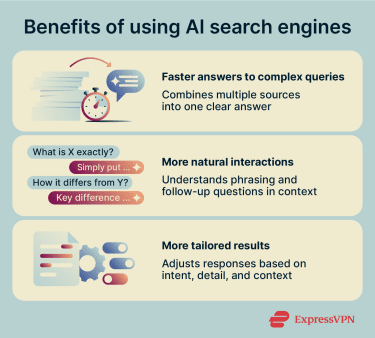
Improved understanding of search intent
Search intent is the reason behind a search. In other words, it’s what the person is trying to find, not just the words they type.
In traditional search, intent is used to decide which pages are most relevant, but the result is still just a list of links. AI search tools can respond directly to how a question is framed. This means the same topic can produce different types of answers depending on the instruction given.
For example, a user could ask, “What is photosynthesis?" "Explain photosynthesis in simple terms" or “Break down photosynthesis step by step for revision.” In each case, the system adjusts the explanation to match the requested level of detail and format, rather than returning the same set of webpages.
This makes intent more directly actionable. The phrasing of a query can shape the structure, depth, and style of the response, not just which results appear.
More relevant and contextual results
Searches are often not about a single topic but about a combination of needs that sit behind a question. For instance, a search for “best phone for travel photography” involves more than just smartphones or cameras. It typically includes factors like image quality, portability, battery life, storage, and budget. A useful result needs to reflect that mix rather than focusing on only one aspect in isolation.
AI search engines are designed to interpret this broader context when processing a query. Instead of treating the search as a keyword match, they can identify the different underlying requirements within the question and connect them to more relevant information.
This is where context becomes important. A result might still be related to the topic on the surface but fail to address what the user is actually trying to compare or decide. By interpreting the full intent behind the query, AI search is more likely to surface information that aligns with the decision being made, rather than just the individual terms used.
AI search vs. traditional search engines
AI search and traditional search engines are trying to solve the same basic problem: helping people find useful information. The difference is mostly in how they approach that task.
One of the clearest differences between AI search and traditional search is how results are presented.
| Traditional search | AI search |
| Returns a list of links, snippets, and featured results. | Often presents information as direct answers, summaries, or structured responses. |
| Helps users discover and access relevant webpages. | Focuses on explaining or synthesizing information from multiple sources. |
| Information is spread across multiple pages that the user can explore. | Brings together key points from different sources into a single response. |
| Involves browsing the web and choosing which sources to open. | Offers a more guided, conversational way to explore a topic, including follow-up questions. |
| Provides direct access to original sources and perspectives. | Often includes sources while also summarizing or interpreting them. |
Where AI search performs better
AI search tends to perform best in situations like these:
- Detailed or layered questions: AI search is often more useful when a query involves multiple ideas, conditions, or requirements rather than a simple one-topic lookup. For example, searching “best Thai food” might return a list of nearby restaurants, while adding a constraint like “on a budget” doesn’t always change the results in traditional searches. AI search is more likely to factor in that added detail.
- Conversational or natural-language searches: It generally performs better when a question is written the way a person would naturally ask it, rather than as a short string of keywords.
- Broad or exploratory topics: AI search can be especially helpful when the goal is to understand a subject, get an overview, or explore a topic without knowing exactly what to look for.
- Comparisons, recommendations, and explanations: It often works well when someone wants to compare options, narrow down choices, or get a quick explanation without opening and piecing together multiple pages manually.
- Unfamiliar subjects: AI search can also be more effective when the person searching doesn’t know the exact terms needed to find the right information.
Where traditional search still has advantages
Traditional search still has clear strengths in situations like these:
- Browsing widely across the web: Traditional search is often better when the goal is to explore many different pages, viewpoints, or websites rather than receive a more guided answer.
- Direct source comparison: It can be more useful when someone wants to compare multiple sources side by side and decide for themselves which ones are the most useful or trustworthy.
- Finding specific websites, pages, or documents: Traditional search often works better for locating exact destinations, such as official announcements, help pages, product listings, research papers, or original reporting.
- More control over the research process: It may also be the better fit when the goal is to manually review, sort, and evaluate information instead of relying on the system to organize it upfront.
- Transparent, link-first discovery: For niche forum threads, official statements, or source-heavy research, traditional search can feel more transparent and easier to navigate at a glance.
- Resource usage and efficiency: Traditional search may be more lightweight in some cases, since it focuses on retrieving existing pages rather than generating responses.
Can you trust AI search engines?
AI search engines can be useful, but they shouldn’t be treated as flawless sources of truth. The same applies to traditional search engines, which can also surface inaccurate or low-quality information. They’re tools for finding and organizing information, not perfect judges of what is correct.
The main difference is that AI search engines add another layer between you and the original source. With a traditional search result, you can usually see which website is making the claim, decide whether you recognize or trust that publication or the organization behind it, and check whether the information was written or reviewed by an expert.
With an AI search engine, you’re also trusting the tool itself. You’re relying on it to choose relevant sources, understand them correctly, summarize them accurately, and present the information without leaving out important context. Even when citations are provided, the answer you see is still shaped by the AI system’s source selection, ranking, and interpretation.
This doesn’t mean AI search engines are inherently unreliable. It means they require a different kind of caution. Instead of only asking, “Do I trust this source?” users also need to ask, “Do I trust how this tool found, interpreted, and summarized the sources?”
For everyday questions, that extra layer may be acceptable. But for sensitive topics, it’s worth clicking through to the original sources, checking who published the information, and comparing more than one reliable source before accepting the answer as correct.
Many AI search tools now include links to the sources they used, allowing users to review the original material alongside the generated response. Good citations make verification easier by allowing the user to trace a claim back to its original source and judge whether that source is reliable, current, and relevant.
Challenges and limitations of AI search
AI search engines are powerful, but they still have clear limits. They’re not perfect at understanding every question, and they’re not guaranteed to interpret information the same way a human expert would. Below are common challenges modern AI search systems face.
Hallucinations and incorrect outputs
A hallucination is when an AI system produces information that sounds believable but is false, misleading, or unsupported.
In technical terms, many AI systems generate responses by predicting the next most likely token based on context. This means the system is designed to produce fluent answers, not to fact-check every statement before presenting it. In some cases, the system may fill in gaps instead of recognizing that it doesn’t have a solid answer. They’re usually written in the same polished tone as accurate information, which can make them harder to spot.
Bias and transparency concerns
AI search engines can reflect bias. Bias, in this context, means the system may favor certain viewpoints, sources, assumptions, or patterns over others. This happens because AI systems learn from existing data, and that data may already contain gaps, imbalances, or skewed perspectives.
If the source material is uneven, the output can be uneven too. Over time, this can contribute to a filter bubble, where users are repeatedly exposed to similar ideas or perspectives, limiting exposure to alternative viewpoints.
Transparency is another concern. In some cases, it may not be clear why a certain answer was generated, why one source was emphasized over another, or what information shaped the final response. That lack of visibility can make it harder to judge whether the result is balanced, complete, or fair.
Privacy and data usage considerations
Privacy is a crucial aspect of AI search because some systems collect and process search activity, prompts, account data, or interaction history. That doesn’t automatically mean something unsafe is happening. But it highlights why users should pay attention to how platforms handle data, including what gets stored, how long it’s kept, and whether it’s used to improve the service.
Tip: For users looking for a privacy-first option, ExpressAI runs inside encrypted confidential computing environments, meaning your prompts, conversations, and files remain private and are never logged, stored, or reused.
The future of AI search engines
AI-driven search is already a part of everyday online experiences. Instead of feeling like a separate tool, it’s increasingly built into how people browse websites, use apps, shop online, and research topics.
Looking ahead, this integration is likely to deepen, with AI playing a larger role in how information is presented, explored, and used across platforms.
Search interfaces are also becoming more flexible. Instead of relying only on short, typed queries, they are shifting toward more natural interactions. This is already visible in features like AI-generated overviews, which present summarized answers directly within search results.
As a result, search may feel less like querying a database and more like interacting with a digital assistant. Interfaces may become more dynamic and responsive, better suited to ongoing exploration rather than one-off lookups.
This reflects a broader change in how people use search. Rather than returning static lists of links, systems are increasingly designed to guide users through information, support follow-up questions, and make results easier to understand from the start.
FAQ: Common questions about AI search engines
Are AI search engines good for research?
Do AI search engines cite their sources?
Can AI search engines summarize web pages?
Is AI search better than traditional search engines?
What AI search engines are available today?
Take the first step to protect yourself online. Try ExpressVPN risk-free.
Get ExpressVPN