Expressvpn Glossary
Data analytics
What is data analytics?
Data analytics is the process of examining raw data to uncover useful information and draw conclusions. It starts with collecting data, like tracking cookies or user activity logs, which is then analyzed to identify patterns, trends, or insights that can inform better decision-making.
How does data analytics work?
The process starts with collecting relevant data, such as numbers from sales, customer feedback, or how people use a website. The data is cleaned to fix errors or remove anything that's not useful and organized in a way that makes it easier to study.
After that, analysts use software tools to look for patterns or trends. This might involve comparing numbers, creating models, or grouping similar types of data. The results can help companies understand what’s working, what’s not, and what steps to take next.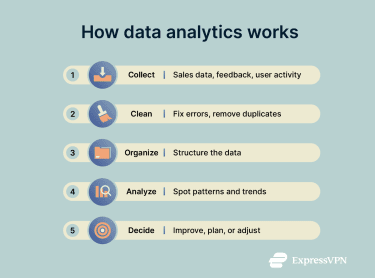
Why is data analytics important?
Data analytics helps organizations make more informed decisions. Instead of guessing, they examine real information to understand what’s going on.
Businesses use data analytics to improve products, reduce costs, plan ahead, or better understand their customers. They find problems, fix broken processes, and avoid wasting time or money.
Where is data analytics used?
Data analytics is used in many industries to solve problems, improve services, and make data-driven decisions. Examples include:
- Business and marketing: Understanding customer behavior, segmenting audiences, measuring campaign results, and improving strategies.
- Healthcare: Supporting better diagnoses, personalizing treatment, and managing public health data.
- Finance: Guiding investment decisions, detecting fraud, and assessing financial risks.
- Education: Tracking student performance, improving teaching, and shaping learning programs.
- Government and public policy: Evaluating public programs and deciding how to use resources effectively.
Further reading
- What is a data warehouse? A complete guide for secure data management
- What are trackers? Understanding how they affect your online privacy
- Data harvesting: What it is and how to stay protected
FAQ
What are the four types of data analytics?
The four main types are descriptive, diagnostic, predictive, and prescriptive analytics. Descriptive shows what happened, diagnostic explains why, predictive looks at what might happen, and prescriptive suggests what to do next.
How is data analytics different from data analysis?
They’re often used interchangeably. However, data analytics refers to the full process of collecting, organizing, and examining data to make decisions, while data analysis is the specific step of interpreting the data.
Is data analytics only used by big companies?
No. While large companies use it at scale, small businesses also rely on analytics to understand customers, improve operations, and make smart decisions.
 Support Center
  FAQ
FAQ  VPN Setup Tutorials