Expressvpn Glossary
Emulator
What is an emulator?
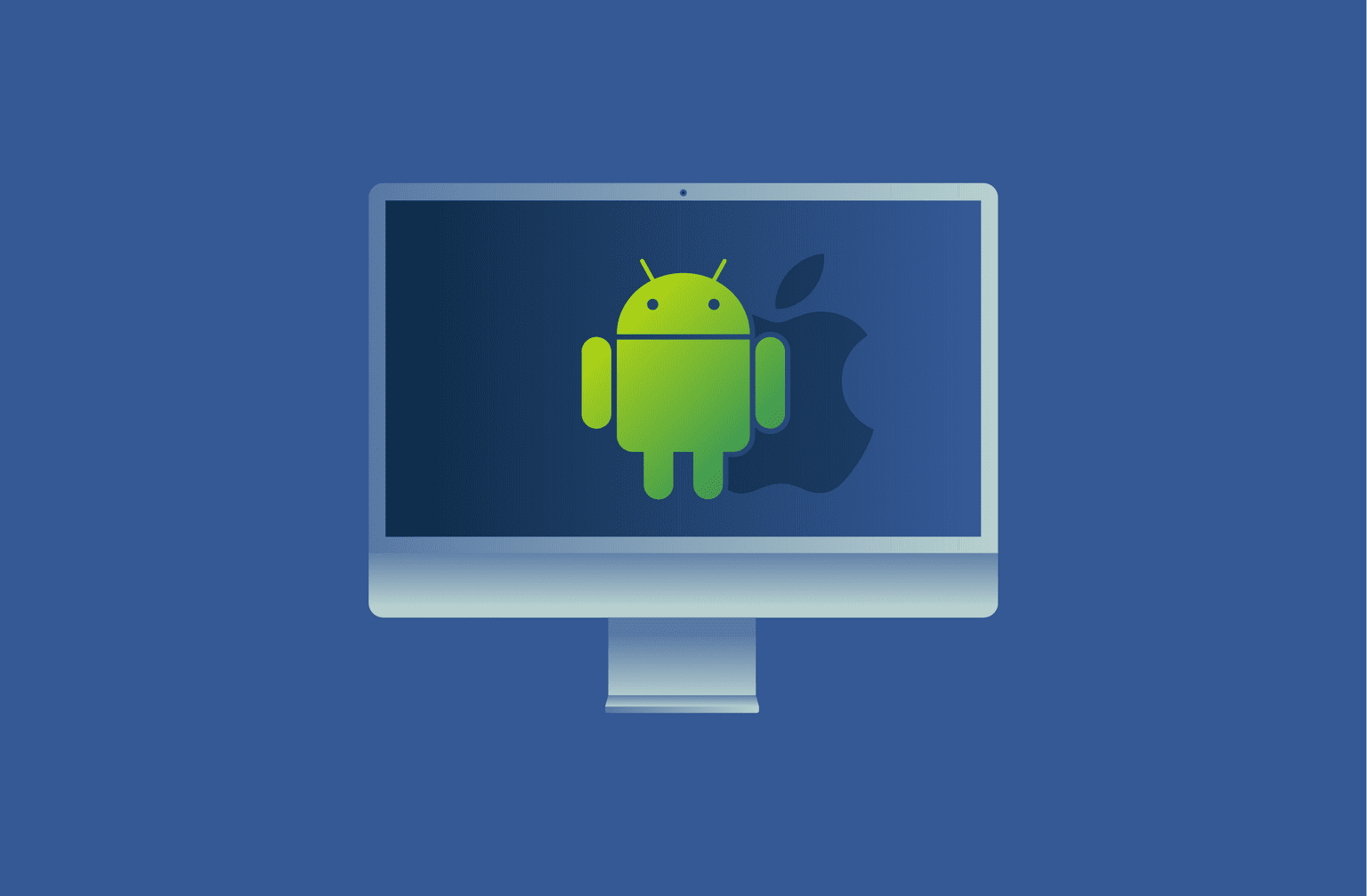
An emulator is any software or hardware designed to mimic the behavior, architecture, and function of another system or application. Emulators are used to run applications or services in settings that were not designed to accommodate them. For example, an Android emulator can allow for the use of Android apps on a Mac computer.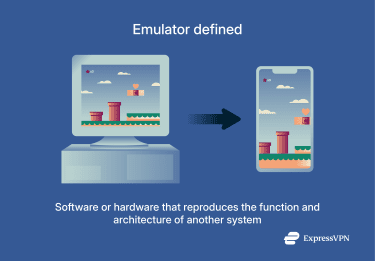
How do emulators work?
Emulators interpret or translate low-level instructions from the system being emulated into a format that the host system understands. They can simulate Central Processing Unit (CPU) instruction mapping, memory emulation, and peripheral equipment.
What are low-level instructions?
Low-level instructions are the basic operations that a device's CPU understands and executes. Each CPU architecture has its own instruction set, expressed directly as machine code (ones and zeroes) and as more human-readable assembly language that maps closely to those same instructions.
For example, the low-level instructions that an older PlayStation understands are fundamentally incompatible with a modern computer. Hence the need for an emulator.
Why are emulators important?
Emulators allow for the preservation of older systems that are no longer accessible, including:
- Old operating systems (OSs), like MS-DOS.
- Hardware platforms, like a Super Nintendo.
- Software that can’t run on modern devices, like video games from the early 1990s.
Emulators are used by cybersecurity experts to test security software on different systems and to analyze threats using virtual hardware. They’re also popular with people interested in older technology as a hobby or for educational purposes.
Common uses
- Gaming: Retro consoles, such as the NES or Sega Genesis, are often emulated on PCs and mobile devices. This provides a way to access old games that would otherwise be unplayable.
- Software development: Developers use emulators to test apps on different kinds of devices. They allow teams to simulate different devices and OSs from one central device, reducing the need for multiple physical devices.
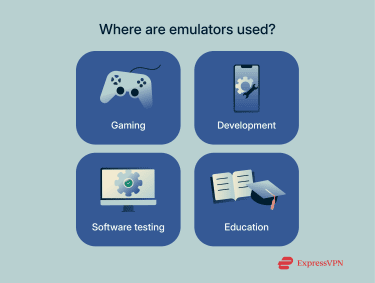
- Software testing: Quality assurance (QA) teams employ emulators in research and development to test various applications and OSs in specific environments.
- Education: In schools, emulators are often used to create controlled virtual environments for learning, without the need for expensive hardware.
FAQ
Are emulators legal?
Yes, emulators themselves are generally legal. The legal issues usually arise from distributing or using copyrighted software without permission.
That said, the line can get blurry, and some companies (most famously Nintendo) have pursued emulator-related projects or users when they believe copyright laws or anti-circumvention statutes are being broken.
Always respect the law in your jurisdiction and make sure you’re using emulators in a legal way.
What’s the difference between an emulator and a simulator?
Emulators aim to mimic the exact inner workings of the app or system they are emulating. Simulators, on the other hand, take a much looser approach, only seeking to replicate the target’s function rather than exactly match its internal architecture.
Are emulators the same as virtual machines?
Not exactly. Virtual machines simulate hardware for running multiple OSs on the same device, but they typically target the same underlying architecture, so many instructions can be passed directly to the host hardware. Emulators, in contrast, actually simulate running the instructions of an entirely different architecture, allowing software from incompatible systems to run.
That said, certain setups combine elements of both approaches, making the distinction less clear-cut than it first appears.
 Support Center
  FAQ
FAQ  VPN Setup Tutorials