Expressvpn Glossary
WireGuard

What is WireGuard?
WireGuard is an open-source virtual private network (VPN) protocol: a set of rules that control the secure flow of encrypted data between user devices and VPN servers. Designed to be faster, simpler, and more secure than older protocols, WireGuard offers a streamlined codebase and modern cryptographic algorithms.
How does WireGuard work?
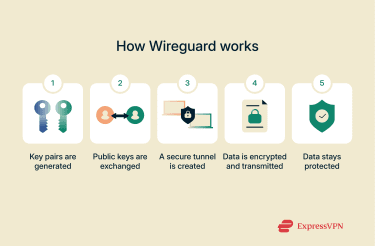
In basic terms, WireGuard creates a secure tunnel between two endpoints, like your device and a VPN server. Here's how it works:
- Key pairs are generated: Each endpoint has a private key (kept secret) and a public key (shared with the other side).
- Public keys are exchanged: When a connection is made, the endpoints exchange the public keys. This process verifies each endpoint’s identity and helps establish secure encryption keys.
- A secure tunnel is created: The key exchange initiates a secure, encrypted tunnel between the devices using lightweight cryptographic protocols.
- Data is encrypted and transmitted: Data is encrypted using the ChaCha20 algorithm and sent through the tunnel via the User Datagram Protocol (UDP), which is faster and more efficient than the Transmission Control Protocol (TCP), especially on mobile networks.
- Data stays protected: Even if someone intercepts the traffic, it remains unreadable without the correct keys, keeping your information private and secure.
Why is WireGuard important?
WireGuard offers benefits over many pre-existing VPN protocols in areas such as speed, security, and performance. For example:
- Lean codebase: WireGuard is made up of just 4,000 lines of code, which is significantly less than the tens of thousands used in alternatives like OpenVPN.
- Faster processing: The lean and lightweight nature of WireGuard ensures it works quickly, even on older or limited devices, since it consumes fewer computing resources.
- Widespread compatibility: WireGuard works across all major platforms, including Windows, macOS, Android, and iOS, despite being originally designed for Linux.
- State-of-the-art security: WireGuard uses the ChaCha20 algorithm, widely regarded as one of the strongest modes of encryption, to encrypt data.
- Superior stability: WireGuard can quickly re-establish a secure connection even if the user changes networks or switches from Wi-Fi to data on a mobile device.
- Post-quantum ready: ExpressVPN has released a post-quantum implementation of the WireGuard protocol.
Despite the benefits, WireGuard is not without its flaws. By default, it assigns static rather than dynamic IP addresses to users and stores IP address data on VPN servers. This can be a privacy issue, but major VPN providers have developed workarounds to resolve it.
Where is WireGuard used?
Examples of real-world use cases include:
- Commercial VPN providers: Almost all major VPN providers include WireGuard as an optional protocol for their users, alongside other protocols like IKEv2, OpenVPN, and ExpressVPN’s Lightway.
- Corporate entities: Many big businesses, particularly those with remote or hybrid teams, use WireGuard for secure communications when working with sensitive files.
- Internet of Things (IoT) device security: WireGuard can strengthen security not only on computers and smartphones but also on IoT devices like smart home technology and wearables.
Further reading
- Comparing WireGuard and Lightway: 3 reasons we created Lightway
- What is the best VPN protocol?
- VPN protocols explained and compared: Which is best for speed, security, and everyday use?
FAQ
Is WireGuard better than VPN?
WireGuard is a type of VPN protocol, not a VPN, so it can only be compared to other VPN protocols. It’s leaner, more secure, and faster than many older protocols, but it’s not necessarily superior to other modern protocols like OpenVPN and ExpressVPN’s Lightway.
What is WireGuard used for?
WireGuard is used to establish secure VPN connections. It protects users’ online traffic, masks their IP addresses, and helps them stay safe while using the internet.
How much does WireGuard cost?
WireGuard is a free, open-source VPN protocol with no licensing fees or charges attached. However, there can be costs involved in learning how to use WireGuard and deploying it correctly on your network.
Is WireGuard VPN safe?
Generally speaking, yes: WireGuard is considered secure and stable. However, it does allow VPN servers to store users’ IP addresses and assigns users the same static IP address each time they connect, which can pose a privacy issue. Major VPN providers that offer WireGuard have come up with solutions for this problem, such as dynamic IP assignment and connection obfuscation.
 Support Center
  FAQ
FAQ  VPN Setup Tutorials